
The best wasp and hornet spray for most people is Spectracide Wasp & Hornet Killer — a jet aerosol that shoots up to 27 feet so you can knock down a nest without standing under it. The whole point of a good wasp spray is distance: a long, straight jet (not a mist) lets you soak a nest and its defenders from well out of stinging range, killing on contact and eliminating the colony. The main differences are spray range and whether it keeps killing returning wasps. Below are the best — every one confirmed in stock. Spray at dusk or dawn when wasps are calm and in the nest, and never spray a nest you’re allergic to or can’t safely reach — call a pro.
How we chose the best wasp & hornet sprays
Every pick was scored against the same criteria, and we confirmed each product is currently in stock on Amazon before including it:
- Real-world quality — materials, construction, and durability, not marketing claims.
- Fit for purpose — sound design and the right fit for the job each product is meant to do.
- Value across budgets — from a solid budget pick to a premium best-in-class option.
- Owner consensus — thousands of verified reviews and Amazon’s Choice standing, cross-checked against known failure points.
Wasp & hornet sprays: the 3 best, compared

The 3 best wasp & hornet sprays, ranked
1Spectracide Wasp & Hornet Killer (27 ft Jet) Best overall
The reach leader: a powerful jet spray that reaches nests up to 27 feet away — the longest here — so you can treat high eaves and out-of-reach nests while standing safely back. It kills wasps, hornets, and yellow jackets on contact and soaks the nest to eliminate the colony, with a non-staining formula that’s kinder to siding. The extra range is a real safety margin when you’re dealing with an aggressive nest. The right pick for most people.
2SpectracidePRO Wasp & Hornet Killer Best residual kill
The pro-grade version, built to keep working: it not only kills the nest on contact from about 20 feet but leaves a residual that kills wasps and hornets returning to the site for up to four weeks — important because foragers away from the nest at spray time will come back. It’s also rated dielectric (safe around energized electrical equipment up to a high voltage), handy for nests near meters or fixtures. The pick when you want returning wasps handled too.
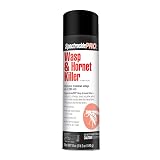
- FAST KNOCKDOWN: Kills wasps, hornets, yellow jackets and mud daubers
- JET SPRAY: This product reaches nests up to 20 feet away
- ELIMINATES THE NEST: SpectracidePRO Wasp & Hornet Killer kills the entire nest and kills returning wasps and hornets for up to 4 weeks
- OUTDOOR USE ONLY: Dielectric breakdown voltage of 47,300 volts
- WHEN TO APPLY: Apply at sunrise or sunset when insects are least active

3Raid Wasp & Hornet Killer Spray Best value
A trusted, budget-friendly jet spray that reaches roughly 22 feet and kills the entire nest — effective on paper wasps, yellow jackets, mud daubers, and hornets, and electrically non-conducting for added safety near fixtures. It does the core job (long-range knockdown of the nest) at a low price, making it the easy pick to keep on hand for the inevitable summer nest. The pick for reliable results without spending much.

- Kills the entire nest.
- Contains In-Wash Pre-Treaters with Active Stain lifters for great stain removal.
- Safe to use in any washing machine and at any water temperature
- Kills wasps & hornets on contact.
- Residual action kills new wasps and hornets returning to nest.
Wasp & hornet sprays: buyer’s guide & FAQ
When is the safest time to spray a wasp or hornet nest?
Why does spray range matter so much?
One treatment or more — and what about returning wasps?
When should I call a professional instead of doing it myself?
More home & household picks, ranked
I’ve spent years writing about and recommending the products people actually live with — the kitchen gear, home goods, and beauty finds that earn their place on a shelf. At Golden’s List I lead editorial across Home, Kitchen, Beauty, and Fitness, digging through reviews, specs, and real owner feedback to separate the genuinely great from the merely popular — and making sure every pick is in stock with a live price before it makes a list. Meet the whole team →